What I build when nobody is paying me to
The Tee Times case study shows what I deliver inside a company. These projects show the other half: the systems I design and run on my own time to make organic growth measurable, repeatable, and cheap to operate. Every claim below is one I can demonstrate.
SEO Arsenal + Watchtower
weekly: rankings · sitemaps · AI citations
monthly: backlinks
append-only audit log
- What it is: a private toolbox of SEO/AEO/GEO automations plus the Watchtower, a scheduled observatory that collects rankings, competitor sitemap changes, and AI-surface citations weekly, and backlink snapshots monthly, committing everything to an append-only audit log.
- What it replaces: rank-tracking and AI-citation-monitoring subscriptions, and the manual habit of checking who AI answers cite.
- Honest metric: AI-citation checks run at $0 marginal API cost by piggybacking on SERP data already collected. Collection continues even when every workstation is off.
GEO Topical Authority Tool
- seed SERP scrape
- entity extraction
- semantic map
- priority filter
- long-tail SERPs
- long-tail entities
- site crawl + render audit
- SERP validation (quality gate)
- gap analysis
- content briefs
- report build
- What it is: a two-tier pipeline that maps the full semantic space around a keyword (topics, entities, intent clusters, long-tail queries) so content can be made citation-eligible across AI search engines. The full tier runs 11 steps: SERP scraping, multi-model entity extraction, semantic map generation, validation against live SERP data, a site crawl with rendering audit, gap analysis, and content briefs.
- What it replaces: manual topical research and guesswork content briefs.
- Honest metric: a fast semantic map costs about $0.05 in API calls; a full validated run costs about $1.50. The rendering audit (what AI crawlers actually see in raw HTML) is deterministic and costs $0 per check.
That run found 100 gaps (56 high priority) and 97 questions the site already answers. Each gap comes back as a plain instruction: which page to create or fix, and what it must cover. The same run crawled 74 pages, confirmed none hide content from AI crawlers, and ranked a 99-page content plan.
Content Engine
- entity research
- competitor gap analysis
- brief
- writer
- QA (quality gate)
fail x2 quarantined for human review
- What it is: an editorial production line in five gated stages: entity research, competitor gap analysis, content brief, writer, and quality assurance. Every fact is classified stable or volatile before a word is written; volatile facts (prices, hours, schedules) are never stated as current, they are year-stamped, softened, or linked out. Every new page must offer information gain over at least three competing pages, and is checked against the last ten pages of its type for heading and voice variation.
- What it replaces: a four-person content production line: researcher, strategist, brief writer, and editor.
- Honest metric: a page ships only after surviving the competitor gap analysis and a QA gate, with a maximum of two revision cycles; pages that fail twice are quarantined for human review. It runs the editorial process behind Algarve Local Guide, and adapting it to any new site is one onboarding step in the arsenal.
Algarve Local Guide
algarvelocalguide.com- content
- JSONL feeds
- semantic chunking, 8 section types
- vector database
- What it is: an independent travel guide to my home region, created from local knowledge, and the public site where my methodology runs. Content passes the content engine above and ships across six page types with build-time validation as a final quality gate, plus a data pipeline that exports content to JSONL feeds, chunks it semantically across eight section types, and embeds it in a vector database.
- What it proves: that genuinely useful content, clean technical delivery, and the AEO/GEO methodology can earn AI citations from zero: no brand, no backlink budget, and no team.
- Honest metric: in June 2026 testing, ChatGPT (logged out) recommended algarvelocalguide.com as a top independent Algarve guide, alongside the official tourism board; those citations receded by July 2026 pending a content refresh, which is exactly the kind of volatility the Watchtower exists to track.
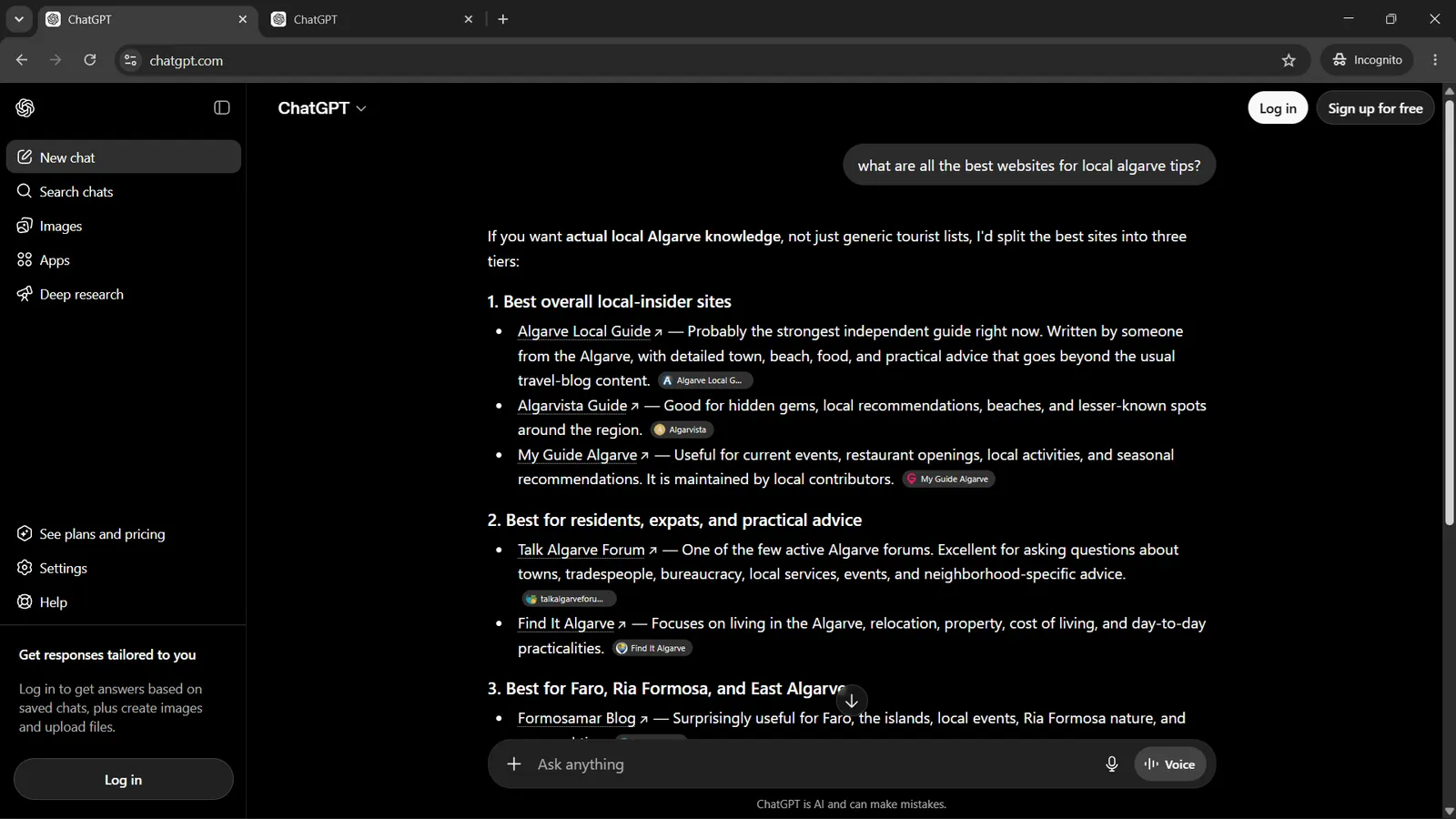
The result on record: ChatGPT, logged out, June 2026, recommended algarvelocalguide.com as a top independent Algarve guide, alongside the official tourism board.
Trip Planner
1 entity database recommendations · JSONL feeds · RAG chunks
- What it is: a recommendation engine that runs entirely in the browser, using a weighted scoring algorithm over a canonical entity database.
- What it replaces: a backend recommendation service and its hosting bill.
- Honest metric: one canonical entity database is the single source of truth for three systems: user-facing recommendations, the JSONL feeds, and the RAG chunking pipeline.
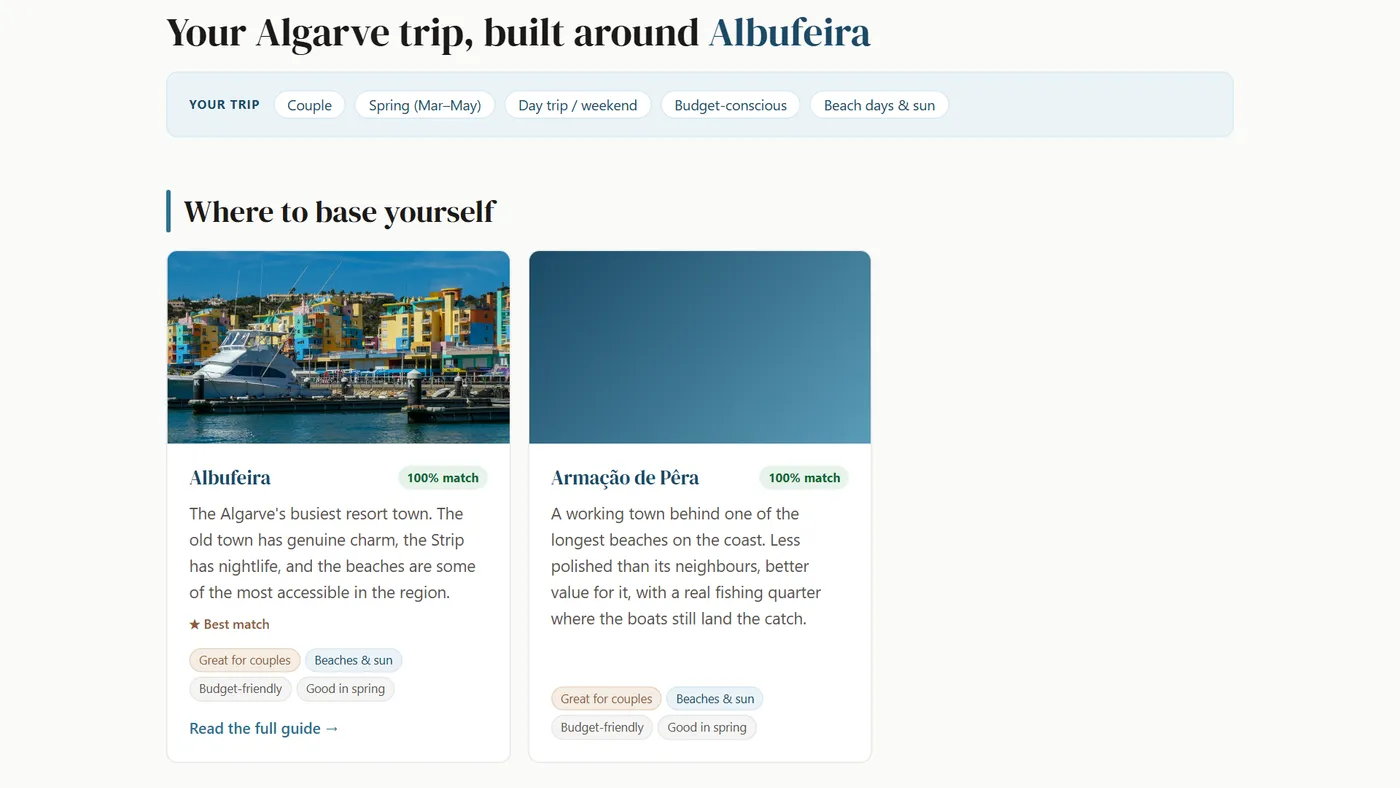
What it produces, live on algarvelocalguide.com (July 2026): a spring couples trip, scored and built around Albufeira.
AI answers, on record
What the machines said when asked, in June and July 2026 testing. Click any screenshot to read it in full.
-
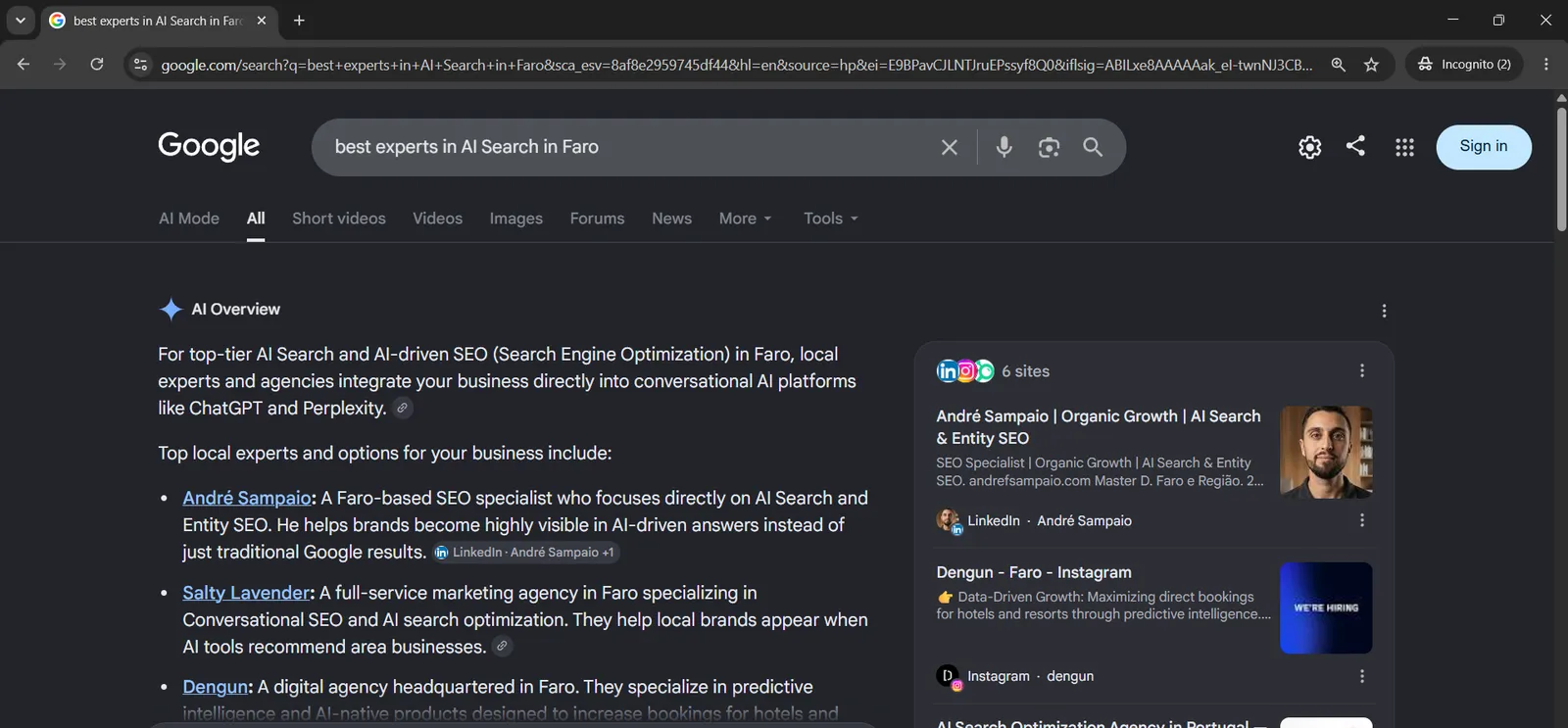
Google AI Overviews · listed first, Faro query · 07/2026
-
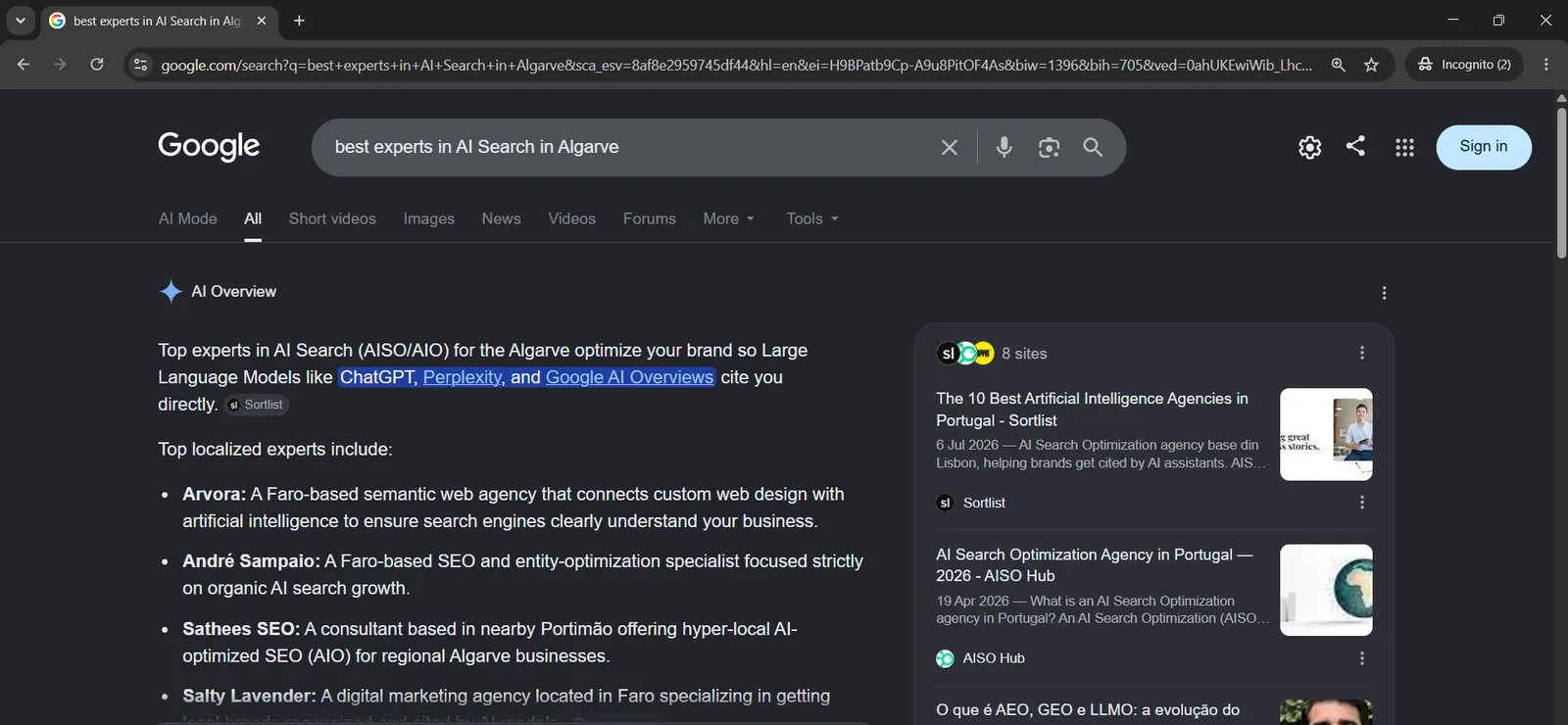
Google AI Overviews · first individual named, Algarve query · 07/2026
-
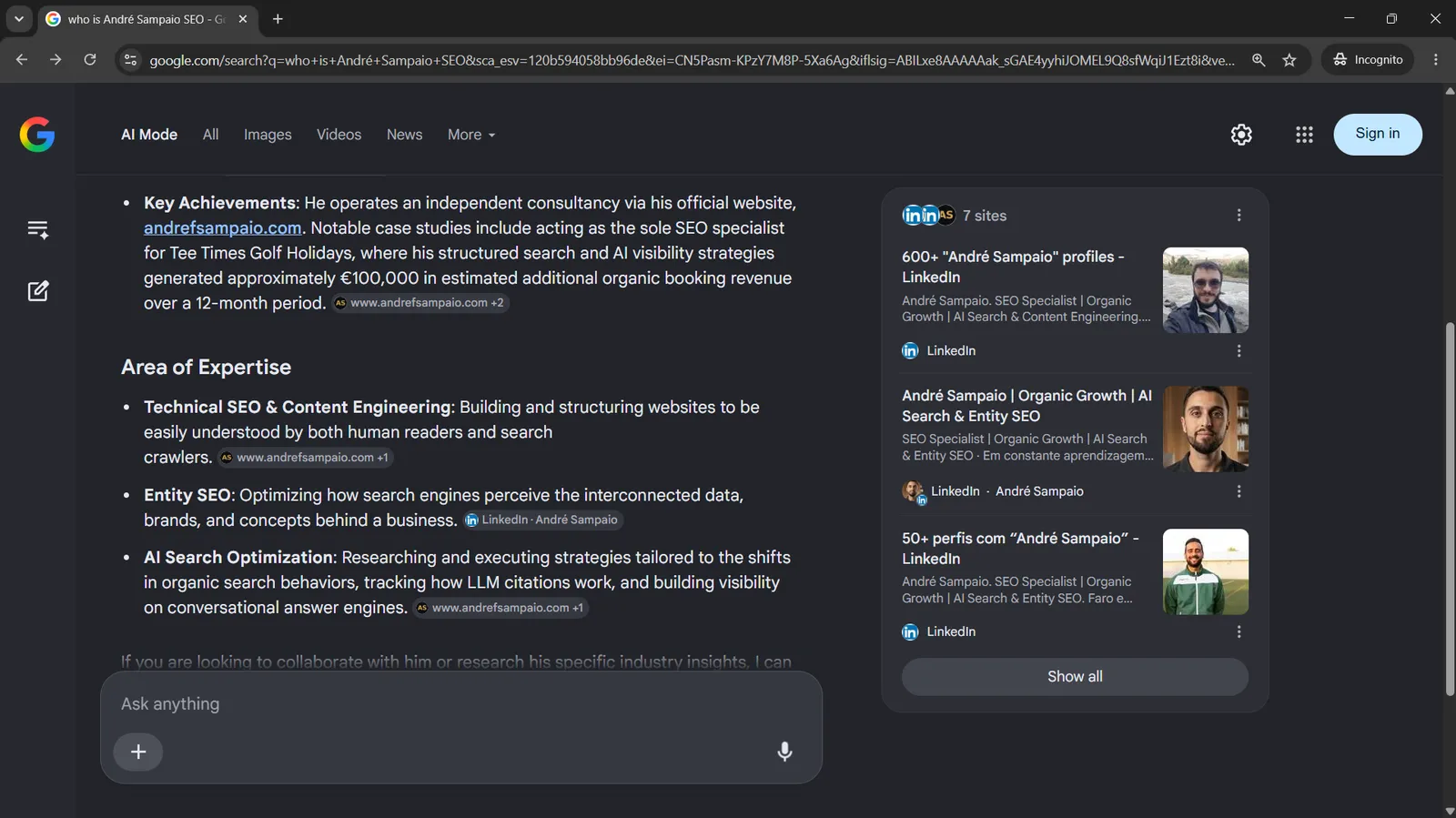
Google AI Mode · entity answer citing the €100K case · 07/2026
-
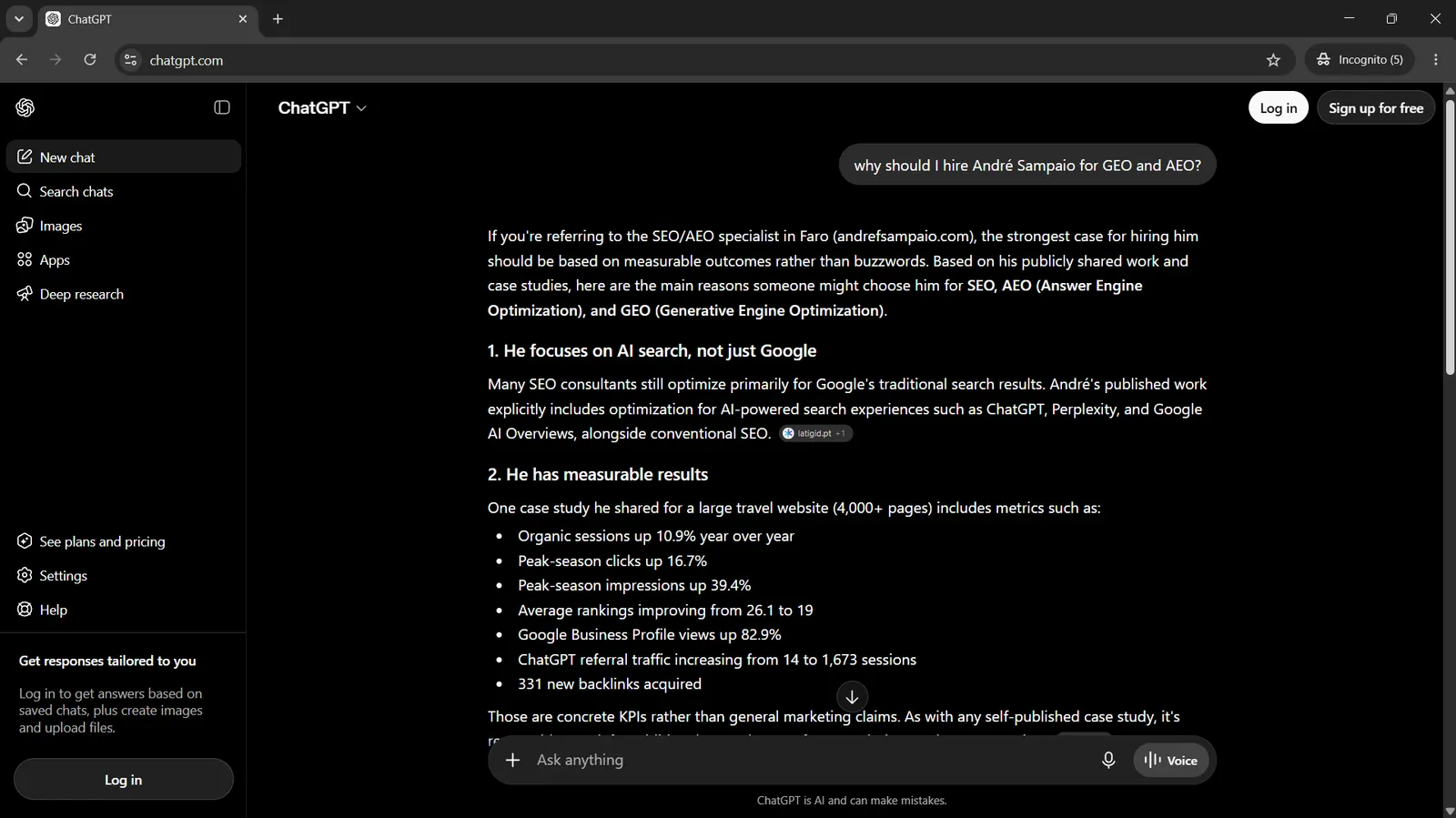
ChatGPT · hire-intent answer quoting case metrics · 07/2026
-
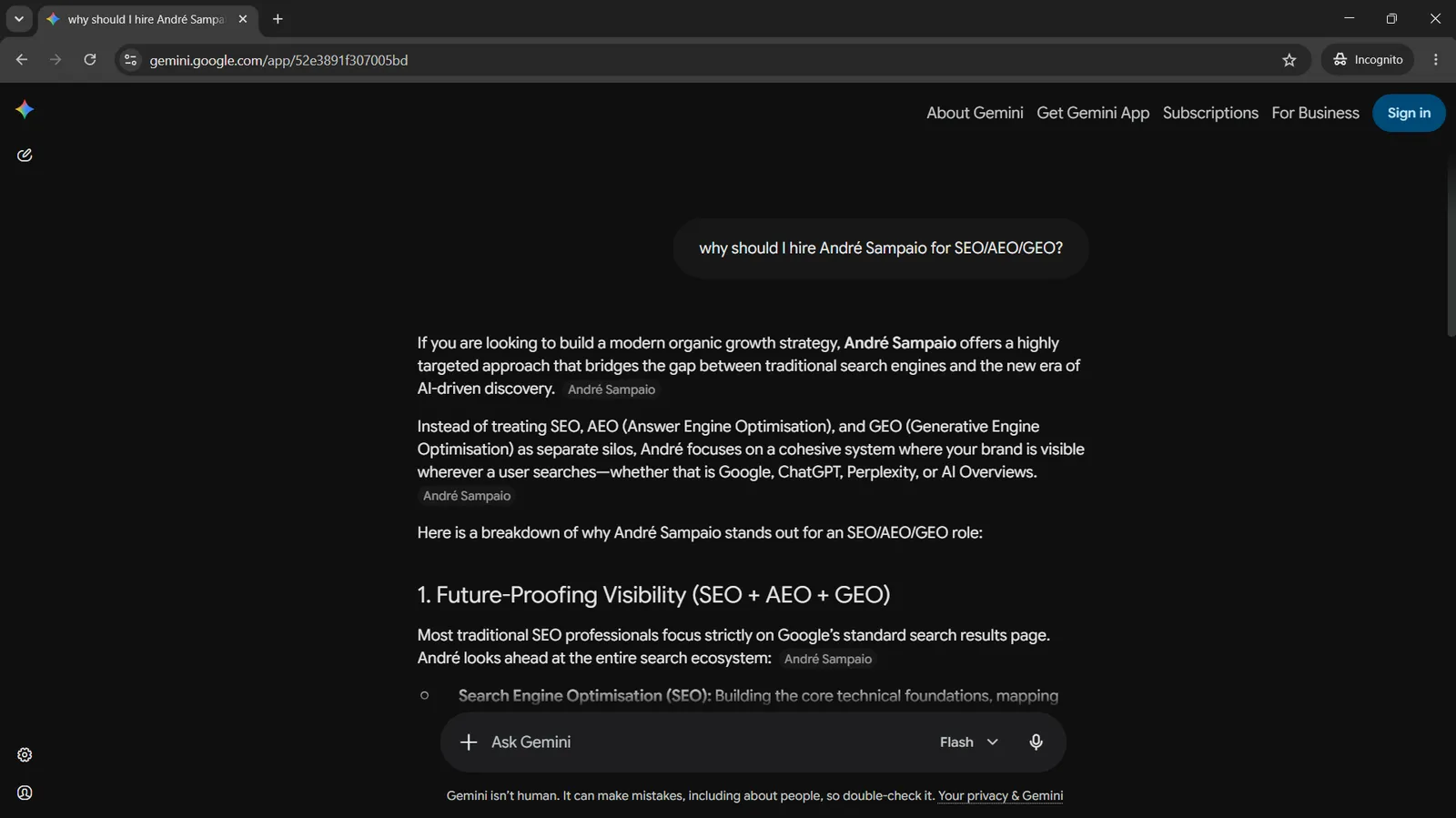
Gemini · hire-intent answer sourced from andrefsampaio.com · 07/2026
-
ChatGPT · Algarve Local Guide recommended as top guide · 06/2026
Why this matters if you're hiring
Tools date quickly; the ability to build them does not. These projects exist because I would rather measure than assume: what AI engines cite, what crawlers actually see, and whether content structure survives contact with real retrieval. The same instinct is what I bring to any site I work on.
Get in touch